And simple truth miscalled simplicity: On a Production of Henry IV, Part 1 — (on the imagination in the theater.)

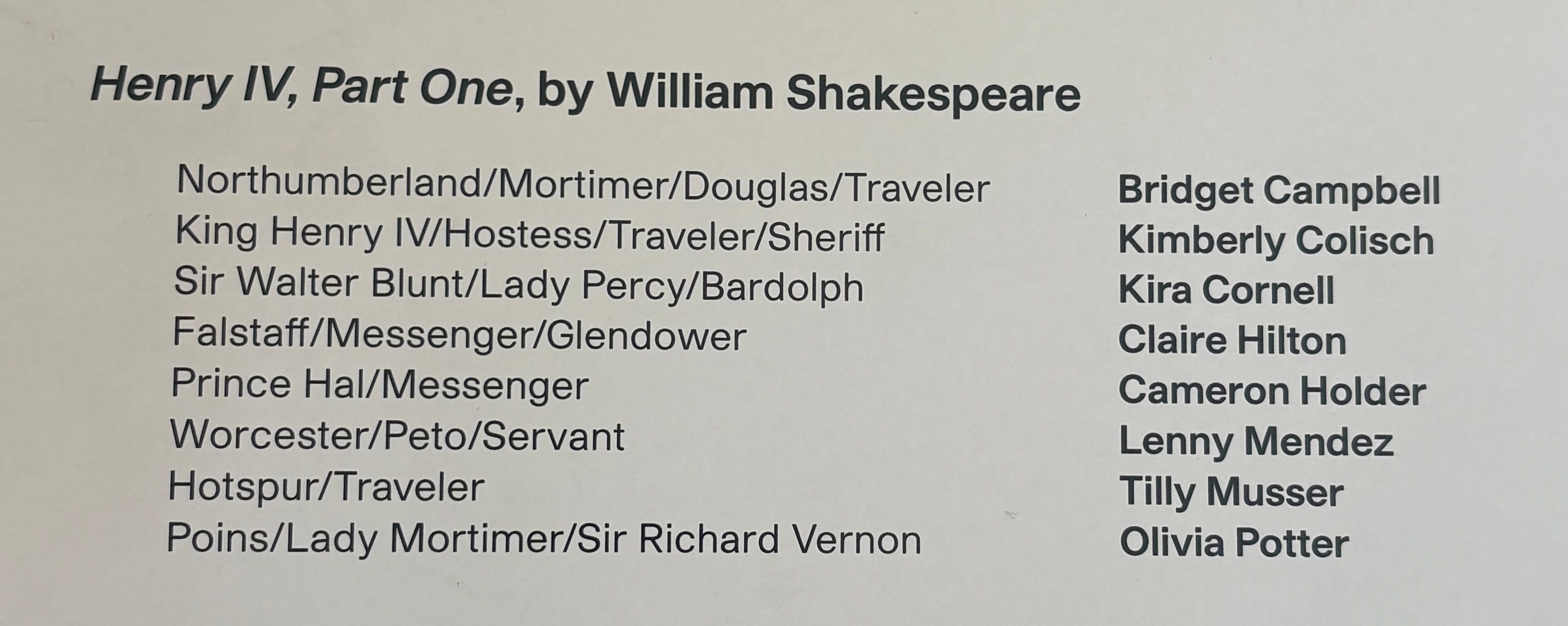
To take inventory of the personal, the production of Henry IV, Part I at hand was one in which my girlfriend, Claire Hilton, was among the cast. The show played for two nights and was directed by Alec Wild for the Shakespeare Theatre Company Academy in Washington, D.C. To consider my thoughts here is to consider my admiration for the performers, the director, and the crew — (and, yes, yes, for the one in particular whose work ethic I am privy to, and in my being privy to it demands from me a scope of possibility I cannot quite imagine wanting to write this without (onward, onward)). Now, to gloss the bit of sonnet in my title: for the assertion that the theater ought to approach a simple truth, I turn to Alain Badiou’s short essay “Theses on Theater,” in which he recalls the French director Antoine Vitez saying: “the theater has to render the inextricable life legible.” Rendering such legibility is evidently no simple task; were it otherwise, the subject would be more extricable. Pursuing these simple truths, this production cast aside any excess and made much of a surface simplicity in its staging; the show was played by an all-female cast, with a minimal set, and no costumes beyond colored scarves to mark stately allegiances. This was not a case of something self-consciously meager managing to punch above its weight; rather, its success resided decisively within the starkness of its stage. The staging became the very means by which the production rendered the inextricable life legible and laid bare its simple truths. Despite my title’s suggestion, it did so with such clarity that those truths could not have been miscalled simplicity. Luís Miguel Cintra, in an introduction to Teatro da Cornucópia’s 1994 production of The Winter’s Tale, wrote the following (translated using DeepL, as was possible for reference, and abridged):
“THE WINTER’S TALE tells me a story that I would like to tell others. And that I would like to understand…. All this pomp and circumstance, this theater with its gilding and velvet, made our task difficult. I preferred our black room, where the story we told was even purer, even more violent... If we love it that much. The next time I tell the same story, I promise, it won’t be in a theater as it should be. When I stage this WINTER’S TALE again, it will be different, less staged. Great texts allow for that.”
To take Henry IV as a story one should like to tell others, and to understand why something “less staged” might most appropriately accommodate that desire, is my want in writing what’s to come. First, to look at the production’s tavern scene to give some idea of its diegesis — then, and more broadly, to attest that in this carefully orchestrated absence of pomp and circumstance, a production can, as this one did, lay full claim to the very idea of the imagination.
If there is difficulty in staging 1 Henry IV without its second part, the trouble is as Samuel Johnson so put, “These two plays will appear to every reader, who shall peruse them without ambition of critical discoveries, to be so connected that the second is merely a sequel to the first; to be two only because they are too long to be one.” Following Johnson, I don’t seek any ambitious critical discovery, but concede to what Orson Welles said of his adapting the plays for Chimes at Midnight, “the relationship between Falstaff and the Prince is not a simple comic relationship... but always a preparation for the end.” Which is to say, Falstaff’s banishment at the end of 2 Henry IV introduces a tragedy of such measure to what critical progeny has deemed history that, had the critical progenitor Sidney lived to see it, he would have necessarily rescinded his objection to the “mingling of kings and clowns.” As Falstaff is not merely thrust into “majestical matters with neither decency nor discretion,” but provides a supreme example of the disparities between our hopes and the inscrutability of consequence in the face of both a cruel political providence, and a refusal to consider, or even to acknowledge, personal limitation. If, as Cavell writes, Othello has an “imagination of stone,” then Falstaff imagines something entirely more alive and flexible, but something equally as stubborn in comprehending agitation. There is something wonderful of the following Montaigne in him,
“I do little consulting about the ailments I feel … Now I treat my imagination as gently as I can, and would relieve it, if I could, of all trouble and conflict. We must help it and flatter it, and fool it if we can. My mind is suited to this service; it has no lack of plausible reasons for all things. If it could persuade as well as it preaches, it would help me out very happily.”
This is, of course, how I read the show. And maudlin as my reading may be, however obviously it is owed to Auden’s Falstaffian sympathies and is reared on Welles’s performance, I do think, in this case, reading the end into more of the whole supplies ample reward. The reward being something similar to what Rhodri Lewis writes of Hamlet and Macbeth’s conclusions, that the end succeeds in advancing a bolder gambit by urging the audience to consider their expectations of how a tragedy ought to conclude. In this case, what ought not result is our sweat in war or esteem in succession being overwhelmed by our sympathies for the fat knight. Though, in the end, we sing with Dr Johnson,
“But Falstaff unimitated, unimitable Falstaff, how shall I describe thee? Thou compound of sense and vice; of sense which may be admired but not esteemed, of vice which may be despised, but hardly detested. Yet the man thus corrupt, thus despicable, makes himself necessary to the prince that despises him, by the most pleasing of all qualities, perpetual gaiety, by an unfailing power of exciting laughter … It must be observed that he is stained with no enormous or sanguinary crimes, so that his licentiousness is not so offensive but that it may be borne for his mirth.”
Then, among ample examples, to parse a single success of the production which is subject here — that it succeeded in Falstaff’s long goodbye with no need for the story’s second part. In her book, The End Crowns All, Barbara Hodgdon makes reference to several scenes that, as it were, rehearse Falstaff’s banishment. One of these scenes is the play within the play at the Eastcheap Tavern, in which Falstaff assumes the part of King Henry IV opposite Hal, before the two reverse roles. The comedy of Falstaff playing the king perhaps reached its full display in a moment when, climbing atop a table to take his throne, he nearly tumbles to the ground amidst a circle of friends; who catch him and heave his weight back to its height. Among my references, it is a moment close to Chaplin’s tramp: comedy born in a rash blindness to danger, pathos awakened by the unexpected sympathies for the endangered (herein, “Alas! the gratitude of men / Hath oftener left me mourning.”) In drumming up comradery with Falstaff this moment prepares us for the reversal, for Hal’s taking of the throne, and for Falstaff’s playing of the prince. Here, we become privy to a rehearsal of Part II’s coronation, and of Falstaff’s banishment.
A.D. Nuttall writes of the expulsion’s recital in his book A New Mimesis, “Notice in this exchange how at one point a laugh is killed, or at least checked. ‘Valiant Jack Falstaff’ raises the laugh but ‘old Jack Falstaff’ silences it with truth. When the Prince answers, from a masklike face, ‘I do, I will’, the secret is out.” Were I ignorant of any timeline, Nuttall’s “masklike” would make me believe he was privy to this production. Hal’s censure was delivered with such stone-faced severity as to be cruelly unnerving, and was matched only by the consternation spread across Falstaff’s face. It was a countenance that, for a moment, conceived of his exile, and tore his enterprise of mind away from Montaigne’s self-persuasion, towards Montaigne’s more ominous recognition that “there are some who, through fear, anticipate the hand of the executioner.” These performances proved a combination that fully apprehended the banishment to come, bearing the full weight of grief in Hal’s loss of the sympathies so freshly stirred in the audience by Falstaff’s toppling off his faux-throne. This fulfillment of such high dramatic yield, all without any “gilding and velvet,” acclimates the audience to something so obviously rewarding in the guise of something that some may have thought so surface-impoverished. These are moments which annihilate certain expectations of what is necessary for the sheer functioning of the imagination. It is to learn that vision alone is helpless in assuaging the mind’s apprehension towards the prospect of mere observation; and that one need not be hand-held towards understanding, but can discern for themselves, with such simple clarity, that our lives might be embodied and arrested in words.
Owen Barfield sums up the incapacity of sheer observation in a passage from his essay “Where is Fancy Bread?” (and if Barfield has written in meer sentences all that I have meant to say in many more, then I remain with Johnson in my lack of ambition for critical discovery, but stand firm in my efforts to elucidate. If even that is absent, alas, forgive me!):
“Had it not been for Shakespeare, Coleridge suggests, we might have gone on resting content with the old notion that poetry is born in man out of the sense-perceptions of their own accord, that it is somehow engendered in the eyes by the mere act of gazing. But that is a mistake. If we accept only what the eye transmits to us, then we are under what he was fond of calling ‘the Despotism of the Eye.’ The senses alone are not a source of imagination. They are now our tyrants. And it is the task of imagination to rescue mankind from this very ‘Despotism of the Eye.!’”
I may temper the claim of tyranny — though I may not. If a patron were to allege, after the previously explored tavern scene, that they simply could not abide owing to the poverty of white hairs affixed to Falstaff’s face, then I would declare tyranny had taken hold. The imaginative work to be done is not to witness or to envision stimuli. The imaginative work is to comprehend the subject itself at all. This is a challenge contingent on much more than what an audience that thinks they need, say, a real horse on stage would like to believe. It is true that to believe one has understood Falstaff because something looks like Falstaff onstage is a failure of the human propensity for imagination, but it is not a failure because one has “seen and not understood,” but because in not recognizing the contingency of representation, one is absolutely precluded from taking part in the attempt of imagining to begin with. It is such a failure strictly because the audience, in being human, has the ability to, and therefore must, recognize within themselves the capacity to let language exercise some claim on thought; to allow themselves, in being prompted by the expressiveness of the language so performed, the license to commune over sharing in the word’s claim on a common search for truth. The onus does not fall on the audience without responsibility being owed to the production itself, it is simply that this production was successful in expressing the language, and therefore in giving the audience an opportunity for said communion.
In his essay “Art and Nature: The Background of The Winter’s Tale”, Yves Bonnefoy makes much of the absent reunion towards the play’s end, he asks, “Why, then, are we not admitted to that moment in time when…father and daughter suddenly recognize each other and are reunited amid tears of joy, their trials seemingly at an end?” Bonnefoy writes that the courtiers’ retelling of the reunion unfolds in images to such a degree that we are invited to regard the unseen reunion as the very essence of an image. In turn, this invites us to question what can be made of the reunion’s veracity, and we recognize that we must ask the same question of the fiction as a whole. Here, then, is why something “less staged” may be the most appropriate manner in which to tell the tale, to pursue the theater’s simple truths. The retelling of the reunion is as sparsely staged as a scene can be, that is, not staged at all, and yet it holds power. For Bonnefoy, it holds considerable power, casting a shadow over the rest of the play, “albeit a luminous one in which a great many questions are reflected.” Precisely because the scene is absent, we are compelled to confront its basest meaning, to wonder whether it occurred at all, and to establish value in the potential for its being fiction alone. Said value arises in the power of the telling, and said telling is revealed most manifestly when an attention to the words themselves (to what exactly is happening) is foregrounded before spectacle. The Winter’s Tale tells us this power exists; Hermione finds it in the tales of her young son, “Come on, and do your best / To fright me with your sprites. You’re powerful at it.” For the power of the telling put another way, we turn to Stevens, “the poem is the cry of its occasion, / part of the res itself and not about it”, herein the cry of the theater’s occasion does not acquiesce to the possible pomp of the stage, but resides within performance, within the words, and within the empty space around them. The power, then, does not rest solely on the image-making as such, but relies on the metric of telling; the courtiers recounting the reunion know this, “the wisest beholder that knew no more but seeing could not say if th’ importance were joy or sorrow; but in the extremity of the one it must needs be.” If one knew no more but seeing, they could not speak of the thing altogether, and so the courtiers’ story of images is truthful, but ingeniously truthful only to the point of its limitation. Ingenious because, the way in which this limitation is overcome is precisely what these questions of the imagination’s faculty rest upon, and exactly what the expressiveness of the language, when successfully performed, illuminates. Because this success is a question of conceding to the image’s limitation, it is, in fact, Cintra’s black room and this Henry IV’s spare stage that are, as he wrote, both purer and more violent.
In seeing this production twice (and muttering all of this to myself) I was taken to agreeing with Charles Williams that Parolles, in All’s Well That Ends Well, gives voice to an idea that is cast over the plays:
“Simply the thing I am / Shall make me live.”
The res itself, not only about it — the cry of its occasion, the thing that Henry IV is, is found in its language, in the power of its telling. It is no simplistic feat that the cast of this show expressed said language to the point of making it live. And where else could the ambition possibly reside? After all, and with Stevens again, “In the end, in the whole psychology, the self, / the town, the weather, in a casual litter, / Together, said words of the world are the life of the world.” To receive this life of the world in the theater is remarkably arresting, and in this case what strikes in equal measure: wonder at the Prince’s rise and woe in Falstaff’s preliminary undoing. That a rise to power be mated to a correspondent dissolution, that the things which are to separate friends be the very same which brought them together, that the banished be the one from whom the banisher drew the greatest vitality — here we understand that, however cautionary, however tendentious, there is something good in Falstaff’s appetite for life; in the inextricable life: good, though fragile; fragile, so despairing; despairing, though magnificent. We remember, “Banish plump Jack, and banish the world,” and, perhaps, we hear Pascal, “All these miseries prove man’s greatness; they are the miseries of a great man, a deposed king.”